How to calculate real profit per product on marketplaces
Find what you really keep from each marketplace sale: fees, shipping, packaging, ads and returns, with a worked example and a break-even price.
8 min read
Your real profit per product is the selling price without VAT minus everything that sale costs you: the goods, the marketplace fees, shipping and packaging, advertising, and a share of what you lose on returns. Most sellers who feel busy but see little cash have counted only the first of these. Below is a method you can repeat for every product, with a worked example you can copy into a spreadsheet.
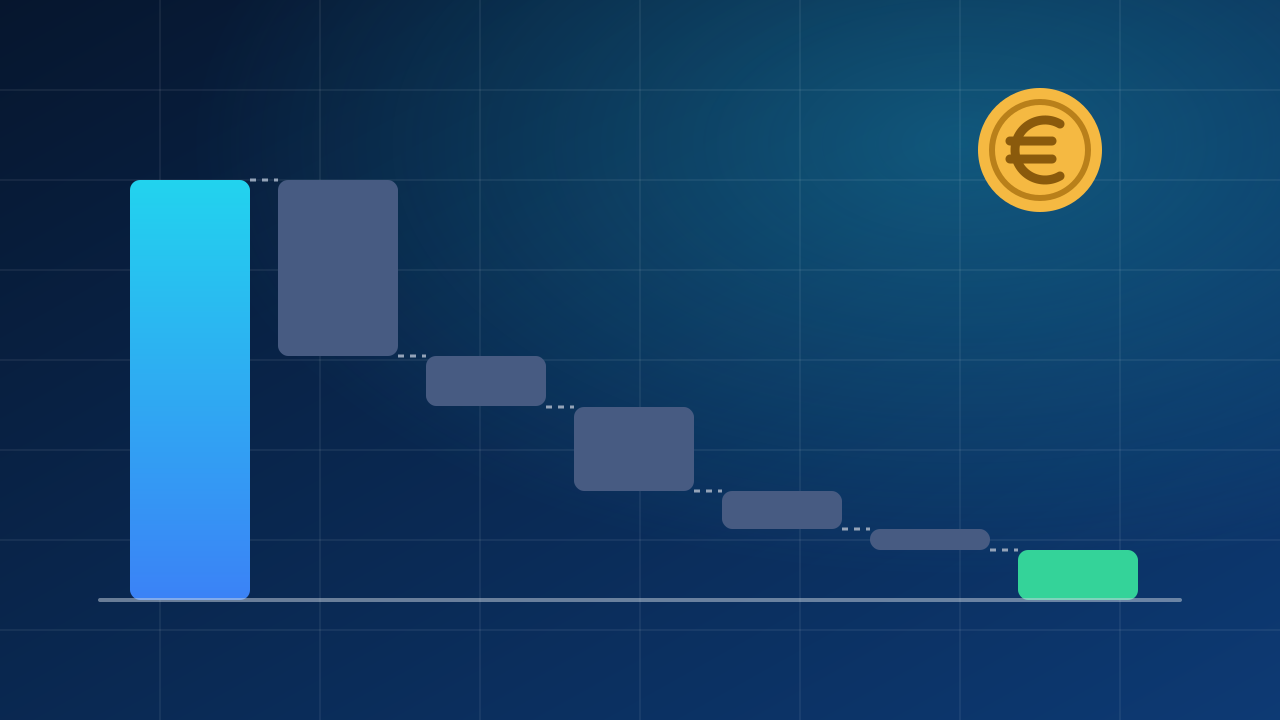
Start from the price you really earn
Work with the price without VAT or sales tax. Where VAT applies, the tax collected from the customer is not your income: it is passed on to the tax authority (how that works in your country is a question for your accountant). If the marketplace shows a price that includes VAT, remove it first, otherwise every percentage below will be wrong.
Then list the costs in the order they happen to an order.
The cost lines most sellers miss
| Cost line | What to check |
|---|---|
| Purchase cost | What you paid per unit, without recoverable VAT. Add the inbound freight and customs per unit, not just the supplier invoice. |
| Marketplace commission | The percentage for your category. Read the fee schedule to see what it is charged on: some marketplaces charge on the item price only, others on price plus shipping or on the VAT-inclusive total. |
| Fixed per-order or per-item fees | Small fixed amounts add up fast on low-priced items. |
| Payment or payout fees | Sometimes included in the commission, sometimes separate. |
| Shipping you pay | The carrier cost, or the marketplace’s fulfilment fee if you use it. If you offer “free shipping”, this is your cost. |
| Packaging | Box, filler, label, tape. Cheap per order, never zero. |
| Advertising | Divide the ad spend by the orders it brought, not by all orders. |
| Storage | Fulfilment-centre storage fees or your own rent, if you can allocate it. |
| Returns | The expected cost of returns, spread over every sale (see below). |
Marketplace fee schedules change and differ by country and category, so take the numbers from your own seller account, not from a blog post, including this one.
Count returns as a cost of every sale
If some share of your orders comes back, that cost belongs to all of your sales, not only to the unlucky ones. For each returned order, ask what you lose:
- Was the commission refunded, or does the marketplace keep it (fully or partly)?
- Who pays return shipping?
- You paid the outbound shipping and packaging: is that money back? Usually not.
- How much of what returns can be sold again as new? The rest is a loss of its purchase cost.
Take the loss per returned order and multiply it by your return rate for this product. Use your own history (returns divided by orders over a few months). If you have no history yet, start with a cautious guess and replace it with real data later.
Worked example
The numbers below are made up to show the method. They are not typical for any marketplace or category.
A bamboo cutting board is listed for €24.20, which includes 21% VAT, so the price without VAT is €20.00. Assume the marketplace charges a 12% commission on the VAT-inclusive price and a fixed €0.30 per order, and you offer free shipping.
| Line | Per unit sold |
|---|---|
| Price without VAT | €20.00 |
| Purchase cost | −€8.50 |
| Inbound freight per unit | −€0.60 |
| Commission: 12% × €24.20 | −€2.90 |
| Fixed fee | −€0.30 |
| Shipping paid by you | −€4.10 |
| Packaging | −€0.45 |
| Advertising per order | −€1.00 |
| Profit if the order is kept | €2.15 |
Now returns. Suppose 6% of orders come back. On each returned order, assume you lose: the commission and fixed fee (€3.20, not refunded in this example), the outbound shipping (€4.10) and packaging (€0.45), the return label (€3.80), and the purchase cost of the 40% of returned items you cannot resell (0.4 × €8.50 = €3.40). That is €14.95 per returned order.
Expected return cost per sale: 6% × €14.95 ≈ €0.90.
Real profit per unit sold: €2.15 − €0.90 = €1.25, or about 6% of the price without VAT.
Compare that with the number many sellers see first: €20.00 − €8.50 = €11.50, a “57% margin”. The difference between the two is not an error in the marketplace; it is the cost of selling there.
Find the price that gives the margin you want
Suppose you want a 15% margin on the price without VAT. Group the costs that do not depend on the price: purchase cost, freight, fixed fee, shipping, packaging, advertising and return cost add up to about €15.85. The commission depends on the price: 12% of the VAT-inclusive price is 14.52% of the net price. So:
Price without VAT = €15.85 ÷ (1 − 0.1452 − 0.15) ≈ €22.48, which is about €27.20 with 21% VAT.
That is roughly 12% above the current price. Now you have a real decision to make: raise the price, negotiate the purchase cost, reduce shipping cost, or drop the product from that marketplace. Without the calculation you would not know that there was a decision at all.
You can check the simpler version of this arithmetic with the free margin calculator. It handles price, purchase cost, other per-unit costs and a single percentage fee, so enter the fixed fees and the expected return cost inside “other costs”.

Margin is not cash
Profit per unit tells you whether a product is worth selling. It does not tell you whether you can pay your bills next month. Two more things to watch:
- Payout timing. Marketplaces often hold the money for some days or combine several orders in one payout, and may deduct fees and refunds from it. Reconcile the payout against the orders it covers.
- Money tied up in stock. A product with a good margin that sits on the shelf for six months costs you cash. Compare margin with how fast the product sells.
For the second point, see the guide to keeping stock records and the reorder point and safety stock article.
A routine that takes an hour a month
- Export a month of orders and payouts from each marketplace.
- For your top 10 products by revenue, recompute the profit per unit with the real fees from the statements.
- Update the return rate per product.
- Mark products below your minimum margin and decide: raise the price, cut a cost, or stop selling them there.
- Re-check the fee schedule once a quarter, and whenever a marketplace announces changes.
If you sell on several channels, the same product can be profitable on one and a loss on another. Our guide to selling on several marketplaces covers how to keep one product record behind all of them.
Common mistakes
- Using the VAT-inclusive price as the starting point.
- Ignoring fixed fees on cheap items, where they can outweigh the percentage commission.
- Assuming returns are refunded in full including fees and shipping.
- Averaging all products together. One loss-making best seller can hide behind ten profitable slow ones.
- Forgetting that a discount hits profit harder than revenue. A 10% price cut on a 6% margin turns the product into a loss unless the costs fall too.
- Never updating the cost. Supplier prices and shipping rates change; a calculation from last year is a guess.
Taxes on your profit and VAT or sales-tax obligations vary by country, and they are outside this calculation. Ask your accountant how they apply to you.
Useful tip. Add a “minimum price” column to your sheet: the costs without commission divided by (1 − commission share − target margin). Every discount can then be checked against the floor at once.
Frequently asked questions
Do I need to calculate profit for every product? Yes, at least for your best sellers and the products with many returns. Averages across the shop hide the loss-makers.
Where do I get my return rate? From your own data: returned orders ÷ orders for that product over several months. For a new product, start with a cautious estimate.
How often should I redo the calculation? Monthly for your main products, and straight away when marketplace fees or supplier prices change.
Keep reading

How to sell on several marketplaces without overselling
One product record, stock buffers per channel, how different fees change your margin, listings, orders and returns, and a safe order for adding new channels.
Full cost per product: what goes into it and how to calculate it
Work out the real cost of each unit before you set a price: freight, customs, labelling and preparation, with a worked example and three ways to split shared costs.
Reorder point and safety stock for a small shop
How much safety stock does a small shop need? A worked example with weekly sales and lead times, a quick rule and a statistical method.
Photos and illustrations
- How to sell on several marketplaces without overselling. Workflow illustration; not a photograph of UBC premises or equipment. Studioarrangement for product photography and video 2298.jpg — © Hubertl / Wikimedia Commons — CC BY-SA 4.0. Resized and converted to WebP. This version of the photograph is available under CC BY-SA 4.0.
- Full cost per product: what goes into it and how to calculate it. Original illustration drawn in code by the UBC editorial team; no third-party material. CC0 1.0. Not a photograph of UBC premises or equipment.
- Reorder point and safety stock for a small shop. Original illustration drawn in code by the UBC editorial team; no third-party material. CC0 1.0. Not a photograph of UBC premises or equipment.
