Full cost per product: what goes into it and how to calculate it
Work out the real cost of each unit before you set a price: freight, customs, labelling and preparation, with a worked example and three ways to split shared costs.
6 min read
The full cost of a product is what one unit has cost you by the time it is ready to sell: the supplier price plus its share of freight, customs, inspection, labelling and preparation, and every other cost of getting it onto your shelf.
Prices, margins and break-even all start from this number. If it is too low, every calculation after it looks better than reality. Below is a method you can repeat for every delivery, with a worked example.
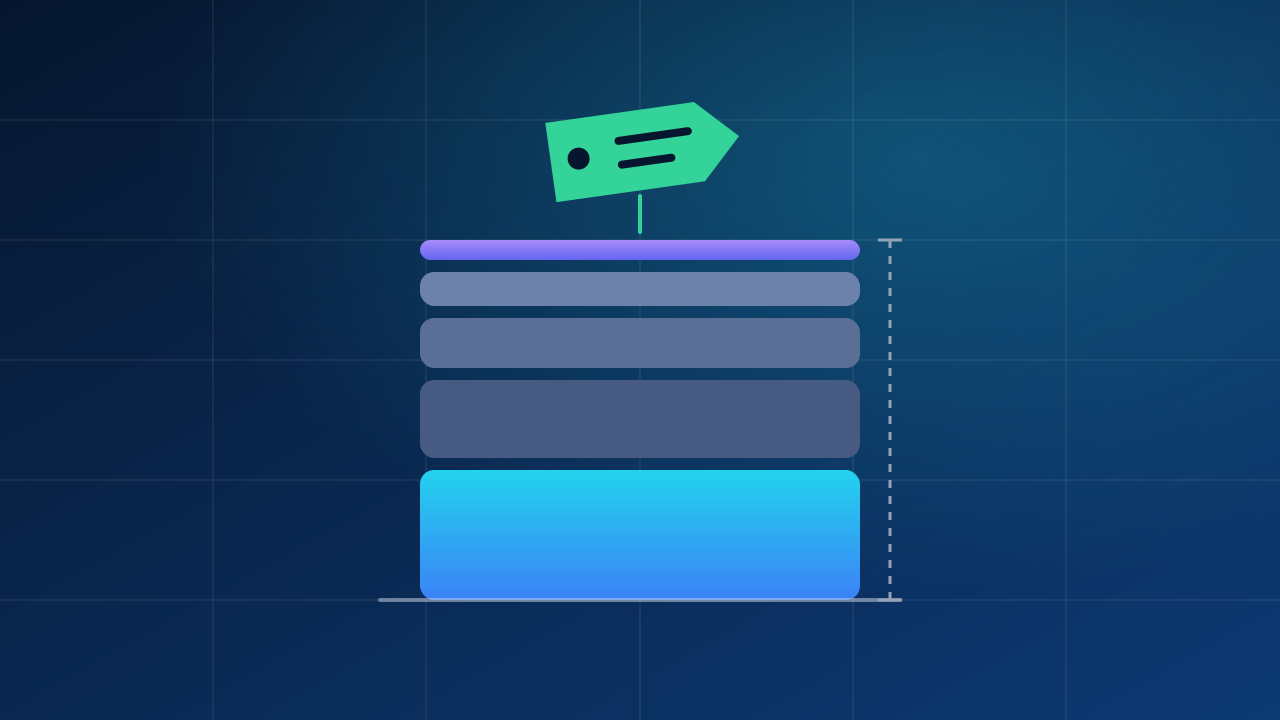
Three layers of cost
It helps to separate three numbers that people often call “cost”:
| Layer | What it includes | Used for |
|---|---|---|
| Unit cost on arrival | Supplier price plus the costs of bringing the goods in: freight, customs duty and clearance fees, insurance, inspection, labelling | Stock value, price floor, margin |
| Cost to sell | Marketplace commission, shipping to the customer, packaging, payment fees, advertising, returns | Profit per order |
| Share of fixed costs | Rent, software, salaries, divided over the units you sell | Break-even and long-term pricing |
This guide is about the first layer, the one the other two build on. The second layer is covered in the guide to real profit per product on marketplaces; the third is what the break-even calculator is for.
What belongs in the unit cost
Use amounts without VAT that you can recover. If you are registered for VAT, the tax on a supplier invoice is usually not a cost to you; if you are not, it may be. Your accountant can tell you which applies.
Then collect every cost that exists only because this delivery happened:
- Supplier invoice: the goods themselves, after any discount.
- Inbound freight: courier, sea or road freight, fuel surcharges.
- Customs: duty and import charges from the customs declaration (in Spain, the DUA), plus the broker’s or carrier’s clearance fee. Take the amounts from your own documents; rates depend on the goods and their origin.
- Insurance and inspection, if you paid for them.
- Preparation: labels, barcodes, repacking before the goods can be sold.
- Currency and transfer fees on the supplier payment.
Leave out the costs of selling and your monthly overheads. They are real, but they belong to the other two layers. Mixing them in makes it impossible to see which part of the cost moves when a supplier, a carrier or a sales channel changes.
Worked example: one delivery, two products
This is an invented order, used only to show the arithmetic; real suppliers, freight and customs bills will differ.
You order 200 phone stands at €3.20 and 100 desk lamps at €9.00. The supplier invoice is €1,540. On top of it you pay €180 for freight, a €60 clearance fee and €62 of import charges from the customs declaration: €302 of shared costs that have to be divided between the two products.
Split by value. The stands are €640 of the invoice (41.6%) and the lamps €900 (58.4%).
| Phone stand | Desk lamp | |
|---|---|---|
| Share of €302 | €125.51 | €176.49 |
| Per unit | €0.63 | €1.76 |
| Supplier price | €3.20 | €9.00 |
| Unit cost on arrival | €3.83 | €10.76 |
If you then label each stand (€0.25) and repack each lamp (€0.35), the unit costs become €4.08 and €11.11. Check that nothing is lost: 200 × €0.63 + 100 × €1.76 rounds back to €302.

Choose how to split shared costs
The same €302 gives different answers depending on the key you choose:
| Split by | Phone stand | Desk lamp | When it fits |
|---|---|---|---|
| Value | €3.83 | €10.76 | Customs and insurance, which follow the value of the goods |
| Quantity | €4.21 | €10.01 | Items of similar size and value |
| Weight (0.2 kg and 1 kg) | €3.63 | €11.16 | Freight, when heavy items drive the price |
None of these is “the right one” for every case. What matters is that you pick a key that matches the cost, write it down and use it every time. You can also split each cost by its own key: freight by weight, customs by value. A spreadsheet handles that in a few extra columns.
Rounding, late invoices and unknown costs
- Rounding. Three identical units bought together for €110.00 cost €36.67, €36.67 and €36.66. The last cent goes somewhere; it does not disappear.
- Late invoices. The freight bill often arrives after the first units are sold. Update the unit cost when it arrives and note what changed, instead of leaving the old figure in place.
- Unknown costs. If you do not yet know a cost, mark the unit cost as incomplete. Treating an unknown cost as zero is how a product looks profitable on paper and loses money in the bank.
- Cancelled lines. If part of an order is cancelled, do not spread shared costs over items you never received.
Use the number
Once you have the unit cost on arrival, the next steps are quick. Enter it as the purchase cost in the margin calculator together with your price, shipping and fee, and you see the profit per unit and the price you need for a target margin. Run the break-even calculator with your fixed costs to see how many units you need to sell each month.
Recalculate whenever something changes: a new supplier price, a different freight rate or a currency move. A unit cost from last year is a guess.
In UBC, each unit or batch keeps its own cost, and receipts, sales, transfers, write-offs and returns move the stock, so the cost stays attached to the goods when they are sold. See what UBC does today for stock and sales.
Common mistakes
- Using only the supplier price and forgetting freight and customs.
- Counting a cost twice, for example adding freight to the unit cost and again as a selling expense.
- Including recoverable VAT in the cost when you get it back.
- Spreading everything by quantity when the items differ a lot in value or weight.
- Keeping the same unit cost forever while supplier prices and freight rates move.
Useful tip. Keep one row per delivery in a sheet: invoice, each shared cost, the key you used and the resulting unit costs. When a product suddenly looks less profitable, you can see in a minute whether the supplier, the freight or the split changed.
Frequently asked questions
Is full cost the same as cost of goods sold? Not quite. Cost of goods sold is the unit cost of the items you actually sold in a period. You need the unit cost first to calculate it.
Should fixed costs go into the unit cost? Not in the stock value. Keep them separate and use them in break-even and pricing, because the share per unit changes with how much you sell.
How precise does the split need to be? Precise enough that the decision does not change. If two keys give almost the same result, use the simpler one.
Keep reading

VAT and sales tax basics for online sellers: a checklist
A plain checklist of VAT, GST and sales tax questions for online sellers, with official authority pages as starting points. No rates or thresholds.
How to reduce costs in a small business
Find every cost in your bank statements, audit subscriptions, free cash tied up in slow stock, cut shipping and supplier costs, and follow a 30-day plan.
How to calculate real profit per product on marketplaces
Find what you really keep from each marketplace sale: fees, shipping, packaging, ads and returns, with a worked example and a break-even price.
Photos and illustrations
- VAT and sales tax basics for online sellers: a checklist. Original illustration drawn in code by the UBC editorial team; no third-party material. CC0 1.0. Not a photograph of UBC premises or equipment.
- How to reduce costs in a small business. Workflow illustration; not a photograph of UBC premises or equipment. ThinkPad T430 (keyboard).jpg — Vitaly Zdanevich / Wikimedia Commons — CC0 1.0. Resized and converted to WebP.
- How to calculate real profit per product on marketplaces. Original illustration drawn in code by the UBC editorial team; no third-party material. CC0 1.0. Not a photograph of UBC premises or equipment.
